Evaluating the Utility of 37 Damaged Cardboard Parts PS Brushes for Digital Texturing
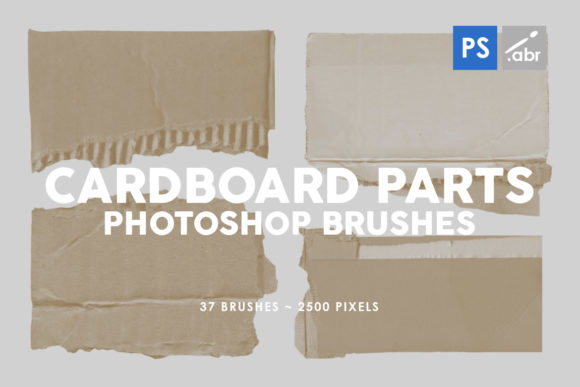
In the realm of digital art and photo manipulation, texture is often the dividing line between a composition that feels flat and one that possesses tangible depth. Among the vast array of resources available to designers, the 37 Damaged Cardboard Parts PS Brushes collection offers a specific, utilitarian aesthetic that caters to grunge, industrial, and realistic collage styles. This set, compatible with Photoshop CS2 through current CC versions, provides high-resolution stamp brushes derived from actual damaged cardboard. Understanding where this specific toolset fits within a broader workflow requires an evaluation of its resolution, versatility, and how it compares to procedural generation or vector-based alternatives.
Defining the Asset: Resolution and Compatibility
The primary distinction of this brush set lies in its source material and technical specifications. Unlike many free brush packs that rely on low-resolution scans which pixelate when scaled, these 37 Damaged Cardboard Parts PS Brushes are built from images sized at 2500 pixels. This resolution is critical for professional work. It allows the artist to apply a texture to a large canvas or a high-DPI print project without the edges becoming jagged or the internal details turning into mud. The "stamp" nature of these brushes means they function more like dynamic stickers or decals than traditional flow-based brushes, making them ideal for placing specific tears, folds, and water-damaged spots with precision.
Compatibility is another significant factor for long-term utility. By supporting versions from CS2 to the latest CC releases, the resource ensures that freelancers working on older legacy systems and agencies running the newest software suites can utilize the same assets. This longevity reduces the friction of adopting new tools and ensures that project files remain editable across different studio environments. For a designer managing a library of resources, knowing that a purchase or download will not become obsolete after a single software update is a practical advantage.
Comparative Analysis: Stamps vs. Procedural Patterns
When evaluating texturing options, designers generally choose between stamp brushes, seamless patterns, and procedural generators. The 37 Damaged Cardboard Parts PS Brushes fall squarely into the stamp category, which offers distinct advantages and limitations compared to the alternatives.
Procedural generators and smart objects are excellent for covering large backgrounds uniformly. If the goal is to create a wall of corrugated metal or a floor of pristine cardboard, a seamless pattern is often more efficient. However, procedural methods can sometimes feel too repetitive or sterile. Real-world damage is chaotic; tears do not follow a grid, and water stains have organic, unpredictable boundaries. This is where the stamp approach excels. Because each of the 37 brushes represents a unique, photographed instance of damage, the resulting composition avoids the "tiled" look that plagues lower-effort texturing. The irregularity of the torn edges and the specific grain of the cardboard fibers provide a level of authenticity that algorithms often struggle to replicate convincingly without significant manual tweaking.
Conversely, the trade-off is control over density. With a flow brush or a pattern, one can easily adjust opacity sliders to create subtle, underlying textures. With stamp brushes, the application is more binary—you place the image or you do not. While opacity can be adjusted post-placement, the workflow requires more deliberate clicking and positioning. For users who prefer painting textures in broad strokes, this set might feel slower than a standard textured brush tip. However, for projects requiring specific focal points of decay—such as a torn corner on a product mockup or a specific water stain on a vintage poster—the precision of stamps is superior.
Practical Applications and Use Cases
The versatility of these high-resolution assets extends beyond simple background creation. Their utility is best understood through specific application scenarios where realism is paramount.
- Digital Photo Manipulation: In compositing, blending two images often requires breaking up hard edges. Applying a damaged cardboard overlay can serve as a natural transition mask, making a superimposed element look like it is physically part of a worn surface.
- Game Asset Design: For indie game developers creating 2D assets or texture maps for 3D models, these brushes offer a quick way to add "wear and tear" decals. Instead of painting damage by hand, an artist can stamp these pre-made tears onto a diffuse map to simulate environmental aging.
- Graphic Design and Branding: Brands aiming for an eco-friendly, raw, or underground aesthetic often utilize cardboard textures in their packaging designs and promotional materials. These brushes allow for the creation of custom distress marks that align with specific brand guidelines without relying on generic stock photos.
- Visual Effects: When creating motion graphics that simulate physical media, these static images can be animated. A sequence of different tear stamps can be used to simulate the progressive degradation of a document over time.
Limitations and Decision Factors
While the 37 Damaged Cardboard Parts PS Brushes are a robust tool, they are not a universal solution for every texturing need. A critical limitation is the specificity of the material. These brushes are explicitly designed to look like cardboard. If a project requires the texture of wet paper, rotting wood, or rusted metal, these assets will not suffice without significant color grading and blending mode adjustments, which may yield suboptimal results compared to using a resource designed for those specific materials.
Furthermore, the count of 37 brushes, while substantial for a niche pack, may feel limiting for artists working on massive, varied environments. In a large-scale scene, an artist might need hundreds of variations to prevent repetition if the same few stamps are used extensively. In such cases, this pack serves best as a "finishing touch" kit rather than the primary texturing engine. It is most effective when combined with other resources—using a seamless cardboard pattern for the base layer and these stamp brushes to add the unique, high-frequency details of damage and wear.
Another consideration is the learning curve associated with blending modes. To integrate these high-contrast black-and-white or sepia-toned stamps into a colorful design, the user must be comfortable with Photoshop's blending options (such as Multiply, Overlay, or Soft Light) and masking techniques. Without proper integration, the stamps can look like they are floating on top of the image rather than being part of the surface. This necessitates a certain level of technical proficiency from the user.
Final Verdict: Is This Resource Right for Your Workflow?
Deciding whether to incorporate the 37 Damaged Cardboard Parts PS Brushes into your library depends largely on the nature of your projects. If your work frequently involves grunge aesthetics, vintage collages, product mockups requiring realistic wear, or game assets needing decay details, this set offers a high-value, time-saving solution. The 2500-pixel resolution ensures that the investment remains viable for print and high-definition digital work, distinguishing it from lower-quality free alternatives.
However, if your design style leans towards clean, vector-based minimalism, or if you primarily work with 3D procedural texturing where every variable is controlled via nodes, these static stamps may see limited use. Similarly, if you require a broad spectrum of materials beyond paper products, this pack should be viewed as a specialized supplement rather than a comprehensive toolkit.
Ultimately, the strength of this collection lies in its authenticity. By capturing real-world damage at high resolution, it bridges the gap between digital perfection and physical imperfection. For the pragmatic designer who values efficiency without sacrificing realism, having a dedicated set of reliable cardboard damage stamps is a strategic asset that streamlines the texturing process and elevates the tactile quality of the final output.